
Reservations are a Tool for National Park Preservation
The Trump Administration has canceled them

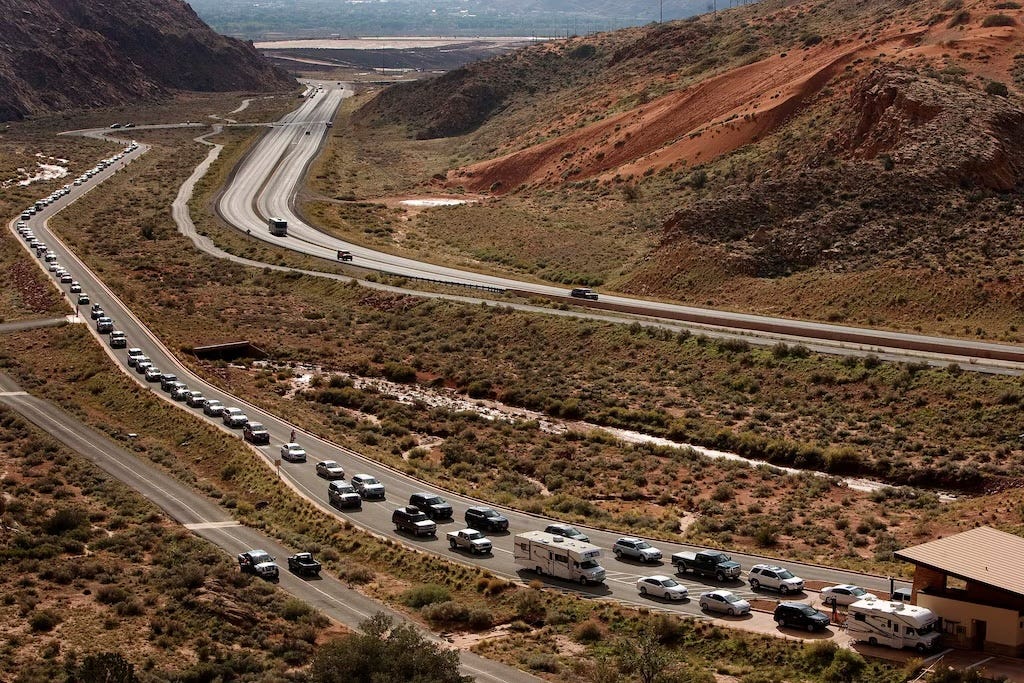
A long line of vehicles queue up to enter Arches National Park in 2013. Photo by Leah Hogsten/ The Salt Lake Tribune
In the summer of 2022, I traveled through the National Parks of Utah with four of my old college friends. With my long career with the National Park Service, I was enlisted to be their park ranger, planning out which park we would visit and where we would go when we got there. Though tempted, I did not use any of my NPS connections, but instead, just like every other visitor, we stood in line, made reservations, looked for parking, and rode the shuttles through Zion, Capital Reef, Canyonlands, Bryce and Arches. Arches NP had recently implemented a timed entry/reservation system and I was interesting in how it was working. It had been developed to prevent lines at the entrance that backed cars out for miles. Some of the entry tickets were available in advance and the rest could be reserved the night before. I waited for the night before and booked on-line a timed entry for the next day. The following morning we got in line at the entrance and showed our reservation to the ranger at the booth, then stopped at the Visitor Center first to get oriented. As I was walking around the center, I was spotted by a ranger whom I had met in the past, giving me a chance to ask how the new reservation system was going. She laughed and said it was really great and “there are no more fist fights over parking spaces!” My friends and I spent the rest of the day in the park, always finding parking along with busy but uncrowded trails.
Preserving our national parks, while simultaneously providing opportunities for enjoyment has been at the heart of the NPS mission for over 100 years. It is fodder for endless debates by conservation organizations, gateway communities and the tourism industry, all looking to see where the thumb rests on the scale: preservation or enjoyment. I have always felt that these two parts of the mission were inextricably linked; to truly enjoy the park experience, it must first be preserved. When making a complex decision, years of NPS experience demands that the thumb rests on preservation first.
The NPS employs an array of systems to meet a standard of preservation while inviting the public to have a safe, inspiring and enjoyable visit. Many of these systems go unnoticed by the public. For instance a well-designed and maintained trail allows the visitor to walk through the park while having minimal impact. The trail also enhances visitor safety and provides for an enjoyable experience. It also keeps their feet off a sensitive resource such as the cryptobiotic soils of Death Valley NP, or the travertine crusts surrounding Yellowstone NP hot pools. But if there are too many people on the trail, impatient visitors step off the trail to pass and that impacts park resources. So there are upper limits to the physical limitations of visitor facilities like trails. The presence of rangers on the trails markedly improves visitor behavior including staying on the trail, not littering, and keeping their distance from wildlife. The Law Enforcement rangers have an additional tool for those who choose to walk off the boardwalk or cross the fence to get a better view. They go home with a special park souvenir, a ticket with a hefty fine. These two systems of well-designed facilities and rangers on patrol are complementary, and work best when both are deployed.
Other visitor management systems include copious forms of information on how to visit without impacting the park: brochures, signs, websites, visitor centers, and walks and talks by rangers. These efforts all have varying degree of effectiveness. Shuttle systems can be very effective at reducing traffic and distributing visitors around the park more evenly. Reservation systems with timed entry are new systems that have already demonstrated their value to both preservation and visitor experience.
With National Park visitation around 320 million, more than all of the Disney Parks, and National Baseball, Basketball, Football and Soccer combined, there is an upper limit to visitation that meets the preservation mission. This is why for popular parks, like Yosemite, Arches, Mt. Rainier, Glacier, and Rocky Mountain a timed entry reservation system makes sense. You don’t walk into the most popular restaurant in your city and just expect to get the best table or a table at all you make a reservation! You make a reservation for a hotel (including the ones in national parks), to rent a car and to fly on an airplane. So why is it so hard for the Trump administration to understand that busy parks also need reservation systems? In these busy parks, a reservation system ensures you will not wait in a miles-long entry line, you will find parking, and when you are hiking the view will be more than the rear of the person directly in front of you. These parks have been implementing successful, as well as popular, reservation systems for several years, but they have all been canceled by the Department of the Interior leadership.
It seems that the Trump administration, specifically Interior Secretary Doug Burgum’s view of the national parks, is akin to an amusement park, where higher visitation is better and the resource is irrelevant. Their actions are to take away the some of the most important tools for park preservation: reduce staff, reduce the budget, and now eliminate reservation systems. The people who look at Yosemite and Rocky and Arches as just entertainment sites are currently in charge. Let’s work to ensure they are gone before they can do permanent damage.